By Michaela Kloeckner
October 2025
As a finalist in the 2025 STILL: National Still Life Award held recently at YAM (Yarilla Arts and Museum), Gerry Wedd was visiting Coffs Harbour to present a talk and workshop in association with the exhibition. Coastal Claymakers were fortunate to host a separate event with Gerry as a guest of the Makers Meet Up and a lucky group of members met the artist and learnt more about him and his way of working.
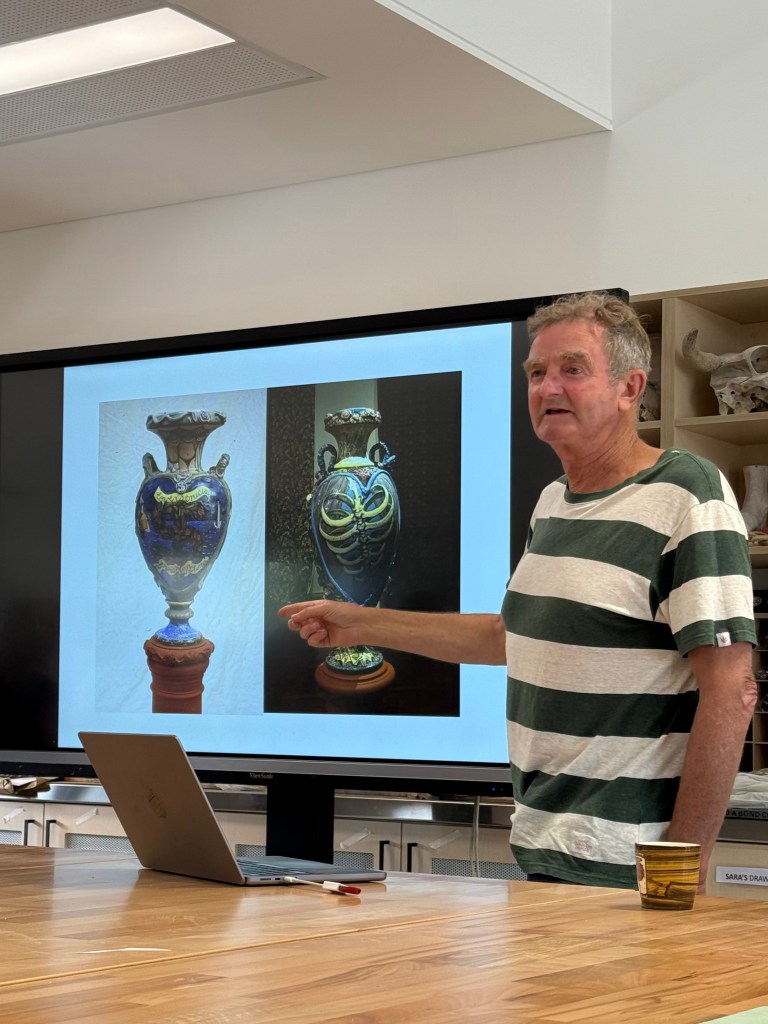
With a career spanning 4 decades his work has been exhibited nationally and internationally and is represented in major collections across Australia. From making little dinner sets out of dug up clay as a child to becoming one of Australia’s most iconic ceramic superstar- Gerry Wedd remains refreshingly humble and down to earth.
Gerry is also well known for his work as graphic designer for the Australian Company Mambo. As a competent surfer his passion often features in his work.
In the morning Gerry gave a talk and presented a slide show of his varied artworks, from still life works to porcelain thongs to his 3D blue willow collection. His impressive tile work installations have been used to create entire rooms and in created a fireplace complete with 3D vases titled Where are We Now as part of The National exhibition, at the Art Gallery of NSW.
He is known for his fine line work in cobalt blue depicting surfers and waves reminiscent of Hokusai on large jars. He also showed us a small collection works he brough with him demonstrating his sgraffito decoration through layers of coloured slips giving the impression of a lino cut. He also shared his work with delicate brushwork in cobalt.
In the afternoon we watched Gerry work (throwing and decorating cups) as he shared entertaining stories and anecdotes from his career. Story telling, song lyrics and playful use of language is a feature of his work.
Other tips and techniques he shared included the way he trimmed the hair away from the outside with the result of leaving a fine point which would create a fine line while the brush would still hold a lot of liquid; and he use of stencils of his favourite drawings to transfer images on pots using charcoal before outlining them with fine lines. A blue body stain in water is used to create a water colour finish.
We all enjoyed spending a leisurely day with Gerry Wedd and we felt privileged to get to know him and his work on a more intimate level. Some lucky people even took a special Gerry Wedd ceramic piece home! You can follow Gerry Wedd on instagram @gerrywedd
 Coastal ClayMakers